The Biological Elite
How Real Food Became a Luxury Good and the Masses Got Slurry

COLD OPEN
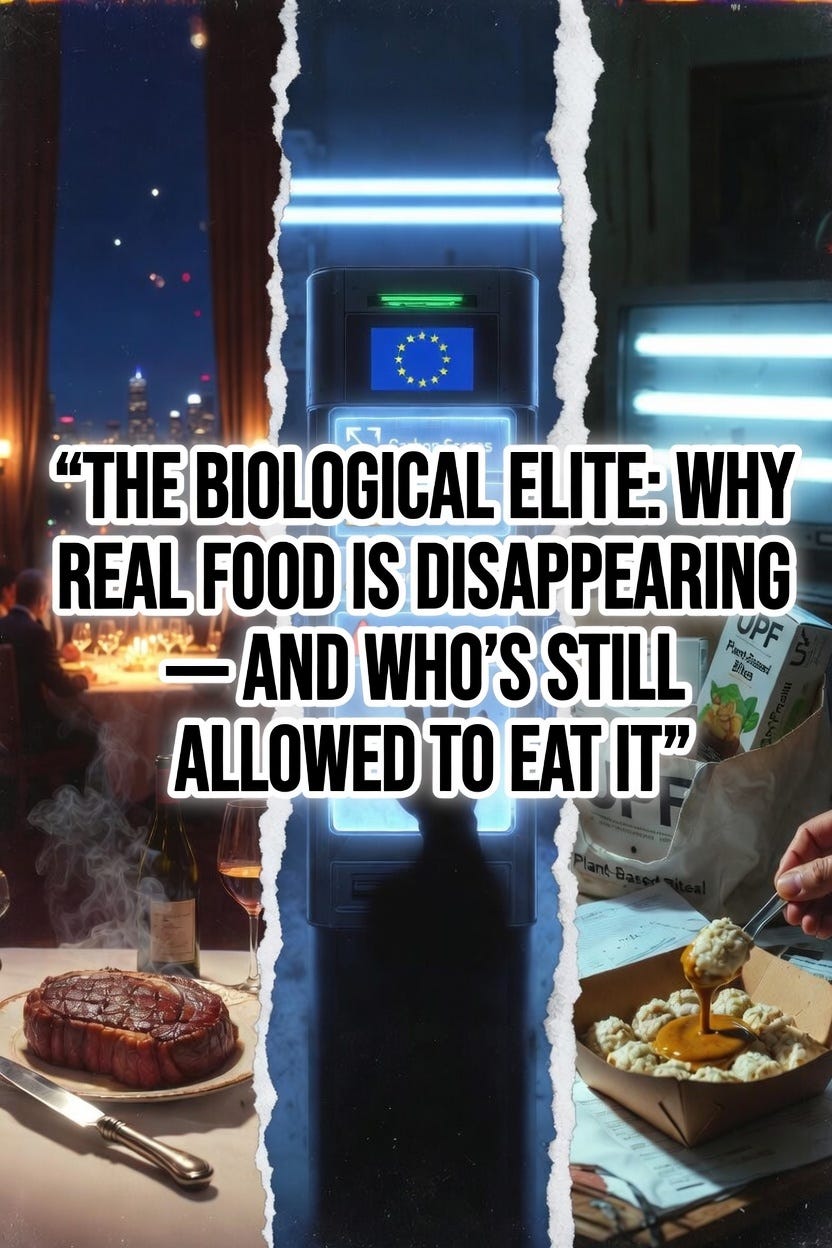
The private dining room overlooked Central Park. No reservation system. No public listing. The kind of room where attendance requires introduction by existing members and net worth measured in nine figures minimum. Seven guests, the kind whose names appear on central bank advisory boards, foundation governance committees, and global policy institutes. The server placed grass-finished ribeye on bone china. Heritage breed, 36-month aging, raised on a Montana ranch one of the guests co-owned. No antibiotics. No grain finishing. Dry-aged in a climate-controlled vault. The owner’s cost for the beef: approximately $35 per pound through his ranch partnership. The same cut at a Manhattan steakhouse would run $400 per plate. This is what structural access buys - biological integrity at preferential pricing while sitting on the panels that write sustainability frameworks and food policy for the rest of the world. The wine was Burgundy, the salad was heirloom tomatoes from a biodynamic greenhouse in Vermont.
Ten blocks south, a software engineer ate dinner at his desk. Chicken nuggets, except no chicken. Precision-fermented mycoprotein textured with methylcellulose and pea protein isolate, fried in seed oil, packaged in recyclable fiber. The box said “Plant-Based Bites.” The ingredient list had 23 entries. Cost: $4.99 for eight pieces. He ate them three times a week. His girlfriend said they tasted fine. He was saving money for a down payment.
Both men were eating protein. Only one was eating food. Only one helped design the architecture that would determine what the other could still choose in ten years.
Welcome to 2026. The year real food completed its transition from staple to status symbol, from commons to luxury enclosure, from what everyone ate to what only the formed can access.
THESIS
In 2026, food has stratified into three tiers. The biological elite eat real food: soil-grown, animal-derived, seasonally dependent, nutritionally complex. The masses eat industrial code: lab-fermented, texturized, shelf-stable, molecularly reductionist. Between them sits a growing middle tier practicing partial sovereignty through backyard production, bulk networks, and preserved knowledge passed from one generation to the next.
This is not a health trend. This is class stratification by nutrient access. Real food is now a Veblen good, a luxury asset whose price rises with demand because owning it signals wealth and knowledge. The bifurcation is economic, biological, and deliberate. But there is still an exit ramp for those willing to work for it.
THE LUXURY TIERING OF REALITY: REAL FOOD AS VEBLEN GOOD
A Veblen good is a product that becomes more desirable as its price increases because the price itself signals status. Rare wines, luxury watches, exclusive memberships. In 2026, add to that list: grass-fed beef, pastured eggs, raw dairy, heritage vegetables.
The Price Signal
The biological premium is measurable and accelerating. Grass-finished beef runs $18-32 per pound retail. Feedlot beef is $6-9. Pasture-raised eggs cost $8-12 per dozen. Conventional eggs are $2.50. Raw milk from a vetted herd, where legal, goes for $15-20 per gallon. Ultra-pasteurized conventional is $3.50. Heirloom tomatoes from known soil cost $8-12 per pound. Hothouse conventional runs $2.
The gap is three to five times, and widening. But the biological elite are not buying cheaper alternatives. They are buying more of the expensive product and treating it as investment-grade nutrition.
The 2026 Global Powers of Luxury Report
The luxury goods sector tracked this shift in real time. In 2026, the fastest-growing luxury category was not handbags or watches. It was food provenance services: farm shares, private livestock partnerships, verified supply chains, estate-grown produce. Ultra-high-net-worth individuals are buying fractional ownership in regenerative ranches the way they buy fractional jets.
The status signal is no longer the car in the driveway. It is the biological integrity of what sits on the plate.
Heritage Integrity Marketing
Brands serving the biological elite do not advertise. They send quarterly reports: soil biology metrics, livestock genetics, pasture rotation schedules, third-party mycotoxin testing. The marketing is data transparency, not emotional appeals. The biological elite want proof, not promises.
A Montana ranch selling grass-finished beef at $28 per pound does not run Instagram ads. It sends veterinary records, genomic testing on grass varieties, and time-stamped slaughter documentation. The customer base includes surgeons, hedge fund managers, retired military officers, and homeschooling families who stopped trusting the industrial supply chain in 2023.
This is not a food product. This is a private library of nutrition, an offline repository of biological truth.
Scripture on Treasure and Value
Matthew 6:19-20 instructs, “Lay not up for yourselves treasures upon earth, where moth and rust doth corrupt, and where thieves break through and steal: But lay up for yourselves treasures in heaven, where neither moth nor rust doth corrupt, and where thieves do not break through nor steal.”
The principle here is priority, not prohibition. The verse does not forbid provision. It forbids misplaced trust. When the biological elite treat real food as investment-grade nutrition, the error is not in recognizing its value. The error comes if that recognition replaces dependence on God’s provision with dependence on wealth as protection.
But there is a second application worth noting. Real food does corrupt. It spoils. It requires cold storage, preservation, seasonal discipline. Synthetic isolates do not spoil the same way because they are not biologically alive. A grass-fed steak left on the counter rots. A precision-fermented protein isolate just dries out.
The biological reality of food is that it is perishable. That perishability is not a design flaw. It is a reminder that food is a living gift, not an industrial product. When food stops rotting, it has stopped being food.
THE UPF TRAP: THE MASSES AND THE NUTRITIONAL UNDERCLASS
Ultra-processed foods are not just convenient anymore. They are the default for the majority of the American population. And the health outcomes are stratifying by class in ways that should concern anyone paying attention.
The Metabolic Bifurcation
Recent meta-analyses link higher ultra-processed food intake with increased risk of depression, anxiety, metabolic syndrome, cardiovascular disease, and all-cause mortality. The associations are robust across large cohort studies. The WHO convened a session on April 10, 2026 titled “Ultra-processed foods: a One Health agenda for action and accountability” specifically to address the systemic role of UPFs in modern food systems.
The data is clear now. Populations with high UPF intake show measurably worse cognitive, metabolic, and mental health outcomes. The masses are not just eating differently. They are functioning differently.
The Cost Trap
The masses eat UPF not because they prefer it but because real food is economically out of reach. A single mother working two jobs cannot afford $12 per dozen eggs and $20 per pound beef. She buys what fits the budget: chicken nuggets at $4.99, mac and cheese at $1.29, frozen pizza at $3.50. The industrial supply chain has optimized for shelf-stable, calorie-dense, cheap.
But cheap food has a biological cost. That mother is not saving money. She is borrowing against her children’s metabolic future. The diet creates dependency: dependency on processed staples, dependency on pharmaceutical intervention for metabolic disease, dependency on the same industrial system that created the problem.
The Cognitive Discount
Multiple studies now show associations between high UPF consumption and impaired executive function, reduced cognitive flexibility, and difficulty with delayed gratification. The mechanistic pathway appears to involve chronic low-grade inflammation, gut dysbiosis, and blood sugar volatility.
Translation: The masses are eating food that makes it harder to plan, harder to delay reward, harder to break free from the system that keeps them dependent. This is not conspiracy. This is biochemistry weaponized through industrial supply chains.
The Biological Elite Opt Out
Tier 1 do not eat UPF. They do not buy industrial dairy. They do not consume seed oils. They source from known producers, often with direct relationships. They pay premium prices and consider it cheap compared to the metabolic cost of eating slurry.
Tier 1 are not morally superior. They are economically able to exit. But the exit itself creates biological divergence. Over a ten-year span, children of the elite and children of the masses are not just eating differently. They are developing differently. Cognitive capacity, metabolic health, gut microbiome diversity, inflammatory markers, all stratifying by nutrient access.
This is the formation of a biological caste system where class is inherited not just through wealth but through nutrition itself.
Scripture on Bread and Serpents
Luke 11:11-12 asks, “If a son shall ask bread of any of you that is a father, will he give him a stone? or if he ask a fish, will he for a fish give him a serpent?”
The principle is provision, not deception. A father gives what nourishes, not what looks like nourishment but harms. The application to 2026 is direct. Industrial systems are giving the masses serpents labeled as bread. Precision-fermented isolates labeled as milk. Texturized mycoprotein labeled as meat. Seed oil labeled as heart-healthy.
The label says food. The biological outcome says otherwise.
THE MIDDLE-CLASS EXIT RAMP: PARTIAL SOVEREIGNTY WITHOUT WEALTH
Listen carefully, because this is where most of you reading this actually live. The bifurcation is not binary. Between the biological elite and the masses sits a third category: middle-class partial sovereignty. These are households that cannot afford $28 per pound grass-fed beef but refuse to accept industrial slurry as default. They exit sideways.
The Backyard Economy
A quarter-acre suburban lot can produce significant biological food without wealth. Six laying hens provide 1,500 to 2,000 eggs per year at a feed cost of $200 to $300 annually. Compare that to retail pastured eggs at $10 per dozen, which would cost $1,250 to $1,667 per year for the same volume.
A 400-square-foot garden plot yields 200 to 300 pounds of vegetables per season with $50 in seeds, compost, and amendments. Tomatoes, zucchini, greens, peppers, beans. The same volume at farmers market prices would cost $600 to $900.
This is not homesteading romanticism. This is economics. A middle-class household spending three to five hours per week on chickens and garden produces $1,800 to $2,500 in biological food value annually while teaching children that food comes from dirt and living creatures, not corporations and patents.
The Bulk-Buying Networks
Middle-class families are forming buying co-ops, splitting whole animals, purchasing 50-pound bags of organic grains, and buying direct from farms at wholesale volume. A quarter cow costs $1,200 to $1,800 for 100 to 150 pounds of beef, bringing cost per pound to $8 to $12 instead of retail $18 to $32.
Families are buying 25-pound bags of organic rice, beans, and oats from restaurant suppliers and splitting them four ways. They are joining CSA programs where $600 to $900 upfront buys a full season of vegetables delivered weekly.
This is not biological elite luxury. This is middle-class strategic provisioning. The household cannot afford private ranch partnerships, but they can afford to opt out of the synthetic default through planning, labor, and coordination.
The Preservation Layer
Middle-class sovereignty includes canning, freezing, fermenting, and root cellaring. A family that grows 200 pounds of tomatoes in August and cans 80 quarts of sauce, salsa, and whole tomatoes has biological food through March. A family that buys 40 pounds of apples in October and makes applesauce has eliminated one more industrial SKU from the cart.
This is not about total self-sufficiency. It is about reducing dependency. Every jar of homemade pickles is one less jar of seed-oil-preserved industrial vegetables. Every dozen backyard eggs is one less purchase routed through the digitally monitored supply chain.
The Knowledge Transfer
The middle-class exit ramp preserves something the biological elite can buy but the masses lose entirely: generational knowledge. When a ten-year-old collects eggs, plants seeds, learns when tomatoes ripen, watches fermentation bubbles in a pickle jar, that child is receiving biological education that no amount of purchased organic food provides.
The biological elite buy biological integrity. The masses accept synthetic dependency. The middle class teach biological sovereignty to the next generation even if they cannot fully fund it.
The Regulatory Threat
This exit ramp is under pressure. Municipal zoning laws prohibit backyard chickens in many suburbs. HOA covenants ban vegetable gardens in front yards. Health departments regulate raw milk, home-processed meats, and cottage food sales into near-impossibility in many states.
The system does not ban middle-class food sovereignty outright. It creates friction. Permits, inspections, compliance costs, neighbor complaints, fines. The message is clear: production belongs to the approved, not the independent.
But the middle-class exit ramp persists because it operates below the threshold of corporate profitability. Monsanto does not care about backyard tomatoes. Tyson does not care about six laying hens. The industrial food system optimizes for scale, and household production is invisible to that scale.
This invisibility is temporary protection, not permanent immunity. As digital identity wallets and food tracking expand, even household gardens may face reporting requirements under One Health biosecurity frameworks if current regulatory trends continue. But for now, the middle class can still plant, raise, preserve, and teach.
Scripture on the Widow’s Mite
Mark 12:42-44 records the widow giving two mites, which Jesus calls greater than the rich men’s large donations: “For all they did cast in of their abundance; but she of her want did cast in all that she had, even all her living.”
The principle is not quantity but proportion and sacrifice. The biological elite buy sovereignty out of abundance. The middle class build it out of labor, discipline, and sacrifice. A family that works five hours per week for $2,000 in annual food value is giving more than a family that writes a $10,000 check to a private ranch partnership.
The widow’s mite is not romantic. It is costly. The middle-class exit ramp requires time, sweat, learning, and persistence. But it preserves what money alone cannot buy: the knowledge that food is something you can produce, not just purchase.
The Strategic Position
The middle-class partial sovereignty model creates a strategic third tier in the bifurcation:
Biological Elite (Tier 1): Wealth-funded, luxury access, private supply chains
Sovereign Middle (Tier 2): Labor-funded, partial biological access, household production plus strategic bulk buying
Nutritional Underclass (Tier 3): UPF-dependent, synthetic default, digitally monitored consumption
The sovereign middle is not as secure as the biological elite, but it is infinitely more sovereign than the nutritional underclass. It preserves optionality. It maintains knowledge. It reduces dependency. It operates outside digital food tracking. It teaches the next generation that sovereignty is possible even without wealth.
This is the exit ramp. It is still open. It will not remain open indefinitely.
The transition from middle-class sovereignty to the digital gate is not a leap. It is a slow tightening of the vise. Let me show you how the infrastructure is already in place.
THE DIGITAL GATE: ELECTRONIC IDENTITY AND PROGRAMMABLE CONSUMPTION
By December 31, 2026, every European Union member state must make at least one compliant EU Digital Identity Wallet available to citizens. The wallet itself is not mandatory for citizens, but the infrastructure creates a programmable gate where one did not previously exist.
The Three-Layer Control Stack
When identity, payment, and classification fuse into a single system, food becomes conditional. Not banned. Just conditional.
Identity Layer: The EU Digital Identity Wallet links national ID with proof of personal attributes like bank accounts, professional qualifications, and health records. It enables selective disclosure and transaction tracking.
Payment Layer: Digital payment rails integrated with the wallet create a legible record of every purchase. Cash transactions remain legal but increasingly inconvenient as point-of-sale systems optimize for digital.
Classification Layer: Codex Alimentarius and national regulators define what counts as food, how it must be labeled, and what claims can be made. These standards determine which products can be sold where.
When these three layers operate independently, consumer choice is opaque to central management. When they fuse, the technical capacity for SKU-level throttling exists whether or not it is currently deployed.
The Nudge Architecture
The wallet does not need to prohibit biological food. It can make synthetic the default through subsidized pricing on precision-fermented products versus biological equivalents, carbon scores on livestock products at checkout, health warnings on saturated fat, red meat, and raw dairy, and purchase limits justified under One Health pandemic preparedness frameworks.
The masses remain fully legible. Their diet is visible, scoreable, and nudgeable through the digital interface. The biological elite opt out by transacting in cash, buying direct from producers, or operating in what the system will increasingly frame as the unmonitored food economy.
The Luxury Exemption
The biological elite do not experience the gate the same way. High-end restaurants, private clubs, farm shares, estate memberships operate outside retail point-of-sale systems. A $500 monthly farm share purchased via wire transfer does not route through identity wallet infrastructure.
The bifurcation is structural. The masses experience food as a managed, monitored, conditional resource. The biological elite experience food as a private, unmonitored, relational exchange.
This is not accidental. Luxury always includes the privilege of opacity. The very wealthy do not need to explain their purchases. The gate is for everyone else.
Scripture on Just Weights
Ezekiel 45:10 commands, “Ye shall have just balances, and a just ephah, and a just bath.”
A just balance requires that both parties can verify the weight. When transactions pass through a digital intermediary that records, scores, and conditions access, the balance is no longer just. It is managed. The buyer and seller are no longer in direct exchange. They are mediated by a system that has its own interests.
The application is blunt. Electronic identity wallets do not facilitate food transactions. They condition them.
THE NARRATIVE INVERSION: MAKING THE NATURAL DIRTY
To lock in the bifurcation, the story told to the next generation must invert biological intuition. Real food must become morally suspect. Synthetic food must become ethically superior.
The Clean Versus Dirty Frame
Synthetic is framed as clean: no manure, no blood, no slaughterhouse, no animal suffering, no factory farms, climate-friendly per selective life-cycle assessments, high-tech, future-proof, space-age.
Biological is framed as dirty: pathogens, feces, contamination risk, animal cruelty, land waste, unsustainable methane and water use, backward, rural, low-status, old.
The One Health framework reinforces this inversion. By linking human, animal, and environmental health into a single risk profile, One Health justifies centralized control over food production. A sovereign 50-acre ranch is unmonitored and therefore unsafe. A bioreactor is digital, air-gapped, transparent, and efficient.
The Youth Capture
The narrative reaches young consumers through influencer campaigns around climate-smart eating and cruelty-free protein, school programs that equate meat and dairy with planetary harm, and youth-targeted products like energy drinks, functional snacks, and gamer foods built on synthetic ingredients and wrapped in environmental and social governance language.
The goal is not just to sell product. It is to moralize the bifurcation. Good people eat clean, efficient, lab-made food. Old, selfish, or ignorant people cling to animals and land.
Once that moral frame lands, the masses will police themselves, defending the very system that keeps them metabolically dependent.
The Rancher Erasure
The narrative never includes the rancher. It never shows the soil, the grass, the carbon cycle, the ecological complexity, the generational knowledge. The rancher becomes a risk vector, not a food producer.
The system does not argue with the rancher. It makes the rancher invisible, then calls the invisibility progress.
Scripture on False Prophets
Jeremiah 23:16 warns, “Thus saith the Lord of hosts, Hearken not unto the words of the prophets that prophesy unto you: they make you vain: they speak a vision of their own heart, and not out of the mouth of the Lord.”
The test of a prophet is not charisma but fruit. When the narrative tells a generation that lab-grown slurry is clean and pasture-raised beef is dirty, that efficiency is virtue and sovereignty is waste, it speaks a vision of its own heart. The vision serves the system that profits from dependency. It does not serve the people who must live inside the consequences.
STATE RESISTANCE: THE LAST LEGAL DEFENSE OF BIOLOGICAL FOOD
Some states are fighting back. South Dakota and Nebraska have both banned cell-cultured protein products. Florida’s ban was upheld by the 11th Circuit in March 2026.
South Dakota Senate Bill 124
Signed March 12, 2026 by Governor Larry Rhoden. Prohibits manufacture, distribution, and sale of any product with cell-cultured protein for five years, from July 1, 2026 through June 30, 2031. Violations are a Class 2 misdemeanor.
The law is temporary, not permanent. But it creates a five-year window where South Dakota’s agricultural base is legally protected from synthetic competition.
Nebraska Legislative Bill 246
Signed May 15, 2025 by Governor Jim Pillen. Classifies cultivated-protein food products as adulterated food under the Nebraska Pure Food Act. This is a permanent ban, not a moratorium.
The law defines cultivated-protein foods as products that resemble tissue from agricultural animals but are derived from manufacturing cells, not meat processing. Lab-grown meat is treated the same as contaminated or unsafe food.
The 11th Circuit Ruling
On March 23, 2026, the U.S. Court of Appeals for the Eleventh Circuit ruled that Florida’s ban on lab-grown meat is not pre-empted by federal law. The court held that a state product ban is different from a regulation of federally inspected facilities. Federal approval does not guarantee market access in every state.
This ruling creates a legal roadmap. States can ban synthetic protein products outright without violating federal pre-emption doctrines.
The Federal Counter-Move
The USDA’s new Product of USA rule took effect January 1, 2026. Single-ingredient products can only use the label if the animal was born, raised, slaughtered, and processed in the United States. Multi-ingredient products must meet the same standard for all FSIS-regulated components.
The rule closes import loopholes. But it also creates documentation burdens. Ranchers must maintain written records proving compliance. For a 50-acre operation, this is bureaucratic siege warfare. For a bioreactor facility with one digital log, it is simple.
The rule is voluntary. But without Product of USA labeling, ranchers lose competitive advantage in a marketplace where consumers value domestic sourcing and transparency.
THE SOVEREIGNTY TIMELINE: HOW THE ENCLOSURE COMPLETES
The bifurcation operates in observable phases. You can see where we are and where this is heading.
Phase 1: Narrative Delegitimization (2020 to 2024)
Biological food reframed as inefficient, unethical, unsafe. World Economic Forum, World Health Organization, and environmental and social governance frameworks position livestock as climate liability. Media coverage emphasizes factory farm cruelty, pathogen risk, resource waste.
Phase 2: Regulatory Compression (2024 to 2026, Current Phase)
Documentation requirements, certification costs, compliance burdens price out small producers. USDA labeling rules, state-level inspections, federal pre-emption battles. The rancher is not banned. The rancher is made economically non-viable.
Phase 3: Digital Gatekeeping (2026 to 2028, Incoming)
Electronic identity wallets and payment integration create technical capacity for SKU-level control. Carbon scores, health warnings, purchase limits become default. Biological food remains legal but increasingly friction-heavy for mass consumers.
Phase 4: Market Inversion (2028 and Beyond, Projected Trajectory)
Synthetic becomes default. Biological becomes exception requiring justification. If current trends continue, supermarkets could stock predominantly synthetic with biological relegated to specialty sections. The biological elite exit to private supply chains. The masses accept slurry as normal.
The timeline is not speculative. Each phase is currently observable. We are in Phase 2 transitioning to Phase 3.
Scripture on Storing Provision
Genesis 41:35-36 records Joseph’s instruction to Pharaoh: “And let them gather all the food of those good years that come, and lay up corn under the hand of Pharaoh, and let them keep food in the cities. And that food shall be for store to the land against the seven years of famine.”
Joseph did not trust abundance to continue. He stored what could be stored. The modern application is direct. The rancher who preserves land, maintains livestock, builds local networks is not preparing for collapse. The rancher is preserving the option to eat outside the permissioned system when the system becomes a cage.
CONCLUSION: THE PRIVATE LIBRARY OF NUTRITION
The 2026 food bifurcation is complete. Real food has transitioned from staple to luxury good, from commons to enclosure, from what everyone ate to what only the formed can access.
The system did not ban biological food. It made biological food economically non-viable for most producers, bureaucratically exhausting for those who persist, and socially suspect for consumers who choose it. Once those conditions are met, the bifurcation completes without force.
The masses accept the slurry because it is cheap, available, and morally approved. The biological elite pay the premium for biological integrity because they understand what is being lost. The sovereign middle build partial sovereignty through labor because they refuse to accept the bifurcation as inevitable.
The land is the private library of nutrition, an offline repository of biological truth in a world of manufactured code. The 50-acre ranch is not a business. It is a hard asset that cannot be remotely accessed, cannot be shut off with an algorithm, produces food outside the permissioned system.
This is structural resilience. The rancher who maintains soil, preserves genetics, and teaches the next generation is not a romantic. The rancher is a steward of biological sovereignty in an age of intellectual property enclosure.
The Word provides the final frame. Revelation 18:13 lists among the merchandise of Babylon: “And cinnamon, and odours, and ointments, and frankincense, and wine, and oil, and fine flour, and wheat, and beasts, and sheep, and horses, and chariots, and slaves, and souls of men.”
The list moves from luxuries to staples to human beings. It is total commodification, where even wheat and beasts and finally souls become tradeable merchandise.
When food moves from biological provision to intellectual property controlled code, from land-based sovereignty to vat-based dependency, from unmonitored exchange to digitally permissioned transaction, the trajectory is the same. What begins as efficiency ends as enclosure. What begins as innovation ends as control.
The formed do not need to be activists. The formed need to be sovereign. Sovereignty begins with land. It continues with refusal. It is preserved by teaching the next generation that food comes from soil, rain, animals, and the work of human hands under God’s provision, not from patents, fermentation tanks, and managed approval of centralized systems.
That knowledge, held and practiced, is the line that does not move.
FOOTNOTES
[1] WHO, Ultra-processed foods: a One Health agenda for action and accountability, April 10, 2026
[2] Regulation (EU) 2024/1183, European Digital Identity Framework, effective May 20, 2024, member state implementation deadline December 31, 2026
[3] South Dakota Senate Bill 124 (2026), signed March 12, 2026
[4] Nebraska Legislative Bill 246 (2025), signed May 15, 2025
[5] Upside Foods, Inc. v. Comm’r, Fla. Dep’t of Agric. & Consumer Servs., No. 24-12381 (11th Cir. Mar. 23, 2026)
[6] USDA FSIS, Voluntary Labeling with U.S.-Origin Claims, Final Rule, effective January 1, 2026
[7] Lane M, et al., Ultra-processed food consumption and adverse health outcomes: systematic review and meta-analysis, The Lancet, 2024
[8] Monteiro CA, et al., Ultra-processed foods and human health, The Lancet, 2025
If this work sharpened your thinking, you can fuel the next report by buying us a coffee.